.webp)
Why Did VOLCANO Tokyo Ban Foreigners?
- Jun 25
- 4 min read
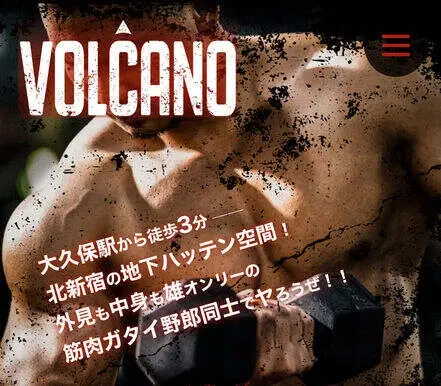
If you've ever visited gay venues across Asia, you've probably heard someone say:
"VOLCANO? Didn't they ban foreigners?""It's racial discrimination.""Japanese people are just exclusionary."
But is it really that simple?
The story of VOLCANO Tokyo goes far deeper than a "no foreigners" sign at the door — and it reflects a growing tension that gay venues across Asia are quietly struggling with.
VOLCANO Tokyo Was Once the Stuff of Legend
For those who've been around the Asian gay scene long enough, VOLCANO Tokyo needs no introduction.
At its peak, men flew to Tokyo specifically to visit this basement venue in Hyakunincho, Shinjuku. Not for the facilities. Not for the décor. But for one reason: the people.
VOLCANO had an almost mythical concentration of young, athletic, short-haired, muscular men. Veterans of the scene will tell you that no other gay sauna in Asia came close during its golden era.
The logic was simple:
Attractive men came → more attractive men followed → even more came.
A powerful positive feedback loop. And that loop was VOLCANO's greatest asset — not the dark room, not the private cabins, not the sling room. The people.
What Started Going Wrong?
Like many niche underground venues, VOLCANO's reputation eventually spread far beyond its original crowd.
Travel blogs. Forum posts. Group chats. Word spread across borders, and VOLCANO Tokyo began appearing on gay travel itineraries across Asia.
And with tourism came a familiar problem.
If you've visited Sauna Mania in Bangkok — one of the most popular gay saunas in Southeast Asia — you've probably seen it firsthand. Or perhaps you've stayed at Togayther Hostel, where the communal vibe sometimes spills over into nearby venues. The pattern is familiar across the region:
A group of ten or more friends arriving together, cruising together, loudly commenting on other guests.
"Oh my god, the guy on the left — he's so hot.""Go talk to him! Go!""Haha, was he just looking at you?"
What was once a space built on silent eye contact and unspoken rules began to feel, for regulars, as if a guided tour group had arrived.
The Decision: Banning Foreigners
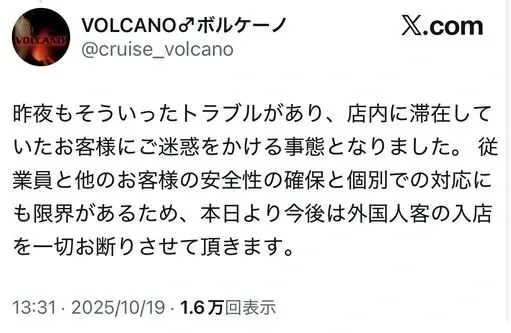
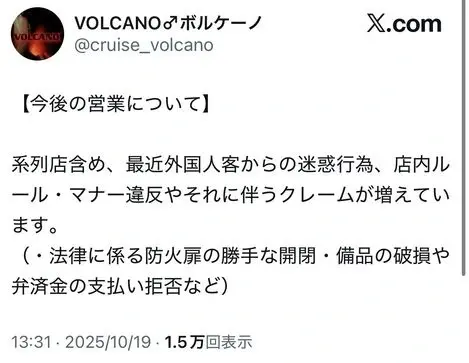
In October 2025, VOLCANO Tokyo made a dramatic move: foreign visitors were no longer permitted entry.
The reaction was immediate and divided. Some called it a necessary measure to preserve the venue's culture. Others called it what it arguably was: racial discrimination — since enforcement was based on appearance rather than behavior.
Both sides had a point.
VOLCANO wasn't wrong that group tourism had changed its atmosphere. But banning an entire group of people based on how they look, rather than how they behave, is a blunt and discriminatory instrument.
The Ban That Backfired
Here's where the story gets complicated.
After foreign visitors disappeared, foot traffic dropped significantly. And to compensate, VOLCANO Tokyo appeared to quietly relax the strict entry standards it had long been known for — the physical appearance and fitness requirements that had defined its door policy for years.
The irony was painful:
The ban was meant to protect the quality of the crowd
But the drop in numbers forced the venue to lower its own standards
Which caused the original regulars to drift away
Which made the crowd quality decline anyway
The very thing VOLCANO was trying to preserve was lost through the act of trying to preserve it.
VOLCANO Tokyo's Impossible Dilemma

VOLCANO Tokyo's Impossible Dilemma
This is the tragic paradox at the heart of the story:
Without the ban: Group tourism continues, atmosphere deteriorates, core clientele leaves.
With the ban: Traffic drops, standards relax, core clientele leaves anyway.
Either road leads to the same destination.
Can VOLCANO Tokyo Ever Come Back?
If VOLCANO Tokyo were to lift the ban tomorrow and welcome foreigners again, could it reclaim its legendary status?
Probably not — at least not easily.
Because what made VOLCANO Tokyo a legend was never a policy. It was a moment in time. A particular generation of men who happened to converge in one basement in Shinjuku, creating a chemistry that can't be manufactured or legislated back into existence.
Some golden eras, once gone, don't return.
The Bigger Question for Gay Travel in Asia
VOLCANO Tokyo's story isn't just about one venue. It's a warning sign.
As underground gay culture becomes increasingly visible — on travel blogs, social media, and group itineraries — more venues across Asia will face the same impossible question:
How do you welcome the world without losing what made you worth visiting in the first place?
Racial discrimination is never the right answer. But the pressure that pushed VOLCANO Tokyo to that decision is real, and it isn't going away.
Have you visited VOLCANO Tokyo? Do you think the ban was racial discrimination, a business decision, or both? Share your thoughts below.


Comments